Wood Pallets
Recycled and new wood pallets in every grade, size, and wood species. The backbone of your supply chain, delivered on your schedule.
Get Wood Pallet Pricing
Tell us the grade, size, and quantity you need. We will respond with a quote within one business day.
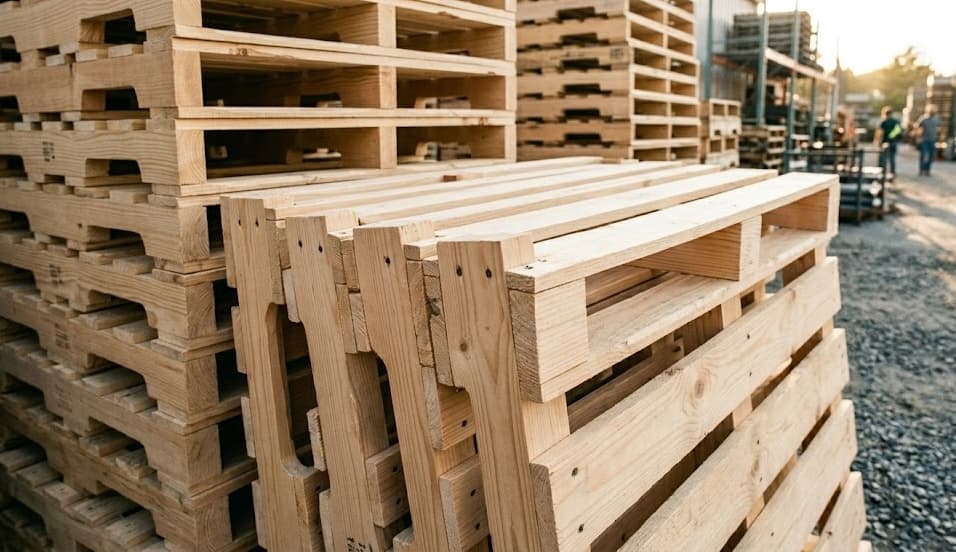
The Complete Guide to Wood Pallets
Wood pallets remain the dominant shipping platform in North America, accounting for roughly 95 percent of all pallets in circulation. Their popularity is no accident. Wood is strong, repairable, recyclable, and cost-effective. At SD Re Pallet, wood pallets are our core product. We stock thousands of recycled wood pallets in our San Diego yard and can fulfill orders from a few dozen pallets to full truckloads of 500 or more.
Whether you are shipping consumer goods across town, staging product in a warehouse, or exporting equipment overseas, choosing the right wood pallet starts with understanding the differences between hardwood and softwood, the grading system, and the standard sizes available.
Hardwood vs. Softwood Pallets
Hardwood Pallets
Hardwood pallets are made from deciduous tree species such as Oak, Maple, and Birch. Hardwood has a tighter grain structure and higher density, which translates to greater load-bearing capacity and resistance to damage. A standard hardwood GMA pallet can safely support static loads of 2,500 pounds or more.
The trade-off is weight. Hardwood pallets typically weigh 50 to 70 pounds, compared to 30 to 50 pounds for softwood. This matters when freight costs are calculated by weight or when workers handle pallets manually throughout the day.
Best for: Heavy loads, long-term racking, international shipping, high-value products
Softwood Pallets
Softwood pallets are built from coniferous species like Southern Yellow Pine and Spruce. Southern Yellow Pine is the most common pallet lumber in the United States. It grows quickly, mills easily, and delivers solid structural performance at a lower price point than hardwood.
Softwood pallets are lighter, making them easier to handle and less expensive to ship. They accept nails cleanly without splitting and are easier to repair. For most domestic supply chain applications, softwood pallets provide more than enough strength while keeping costs down.
Best for: Domestic shipping, lightweight goods, high-turnover operations, cost-sensitive budgets
Not sure which wood type is right for your application? Our Wood Types & Durability guide covers density ratings, moisture resistance, and load capacity by species in detail.
Pallet Grades: A, B, and C
We sort every recycled pallet into one of three grades based on structural integrity, cosmetic condition, and dimensional accuracy. Here is what each grade means for your operation.
Premium / Like New
- All boards intact with no cracks or splits
- Stringers in excellent condition, no repairs
- Clean appearance, minimal staining
- Tight dimensional tolerances
Ideal for retail display, pharmaceutical supply chains, and any application where appearance and consistency matter.
Standard / Good
- Minor board repairs or replacements (1-2 boards)
- Stringers may have companion repairs
- Some cosmetic wear, staining, or weathering
- Structurally sound and fully functional
The best value for domestic shipping, warehouse storage, and general supply chain use. Our highest-volume grade.
Economy
- Multiple board replacements
- Visible repairs and cosmetic imperfections
- Mixed lumber species possible
- Meets basic load-bearing requirements
Best for one-way shipments, temporary storage, and applications where cost is the primary concern. Still structurally safe.
For a detailed breakdown with photos and load specifications, see our Pallet Grading Guide.
Standard Sizes We Stock
We keep the most in-demand pallet sizes ready for immediate pickup or delivery. Need a non-standard dimension? We build custom pallets to order.
| Size (inches) | Common Name | Primary Use | Availability |
|---|---|---|---|
| 48 x 40 | GMA Pallet | Grocery, retail, general freight | In Stock |
| 42 x 42 | Telecom / Paint | Telecommunications, paint drums | In Stock |
| 48 x 48 | Drum Pallet | Drums, barrels, square loads | In Stock |
| 36 x 36 | Beverage Pallet | Beverages, small footprint goods | Limited |
| 48 x 45 | Automotive Pallet | Automotive parts and assemblies | In Stock |
| 31.5 x 47.25 | Euro Pallet (800x1200mm) | European imports/exports | By Request |
Visit our Pallet Size Guide for detailed dimensions, weight capacities, and information about GMA pallets and Euro pallets.
What Affects Wood Pallet Pricing
Wood pallet pricing depends on several interrelated factors. Understanding them helps you make smarter purchasing decisions and optimize your pallet spend.
Grade
Grade A pallets command a premium over Grade B and C. The price spread between grades typically ranges from $2 to $5 per pallet, making Grade B the best value for most applications.
Wood Species
Hardwood pallets cost more than softwood due to higher raw material prices and slower growth cycles. The premium is typically 15 to 30 percent above comparable softwood pallets.
Size and Configuration
Standard 48x40 pallets are the most affordable due to high supply. Non-standard sizes require custom cutting and cost more. Four-way entry, block pallets, and wing pallets carry premiums.
Order Volume
Bulk orders earn meaningful discounts. Truckload quantities of 400 or more pallets offer the best per-unit pricing. We also offer scheduled delivery programs for consistent-volume buyers.
Treatment
Heat treatment (ISPM-15) adds cost but is required for international export. Kiln-dried pallets for moisture-sensitive goods also carry a modest premium.
Market Conditions
Lumber commodity prices affect new pallet costs directly and recycled pallet costs indirectly. Seasonal demand peaks in Q4 can tighten supply on popular sizes.
Detailed Specifications by Grade
The table below provides a comprehensive comparison of our Grade A, B, and C recycled wood pallets across key performance metrics, typical applications, and approximate pricing for the standard GMA 48x40 size.
| Specification | Grade A (Premium) | Grade B (Standard) | Grade C (Economy) |
|---|---|---|---|
| Dimensions (standard) | 48" x 40" +/- 1/8" | 48" x 40" +/- 1/4" | 48" x 40" +/- 3/8" |
| Static Load Capacity | 3,500 - 4,500 lbs | 2,800 - 3,800 lbs | 2,000 - 3,000 lbs |
| Dynamic Load Capacity | 2,500 - 3,000 lbs | 2,000 - 2,800 lbs | 1,500 - 2,200 lbs |
| Racking Capacity | 1,800 - 2,500 lbs | 1,200 - 2,000 lbs | Not recommended |
| Weight (typical) | 45 - 55 lbs | 40 - 55 lbs | 35 - 55 lbs |
| Board Replacements | 0 (all original) | 1 - 2 boards max | 3+ boards possible |
| Stringer Condition | No repairs, no damage | Companion repairs OK | Multiple repairs OK |
| Price Range (48x40) | $9 - $12 | $6 - $9 | $4 - $7 |
| Typical Uses | Retail display, pharma, racking | Domestic shipping, warehousing | One-way shipments, temp storage |
| Expected Trip Count | 8 - 15 trips | 5 - 10 trips | 1 - 5 trips |
Prices are approximate and vary based on volume, market conditions, and wood species. Request a quote for current pricing on your specific requirements.
Wood Species Comparison
The species of wood used in a pallet directly affects its weight, strength, durability, and cost. Here is a comparison of the most common pallet lumber species available in our San Diego inventory.
| Species | Type | Density (lb/ft3) | Janka Hardness | Nail Holding | Best For |
|---|---|---|---|---|---|
| Southern Yellow Pine | Softwood | 34 - 41 | 690 lbf | Excellent | General purpose, high volume |
| Red Oak | Hardwood | 44 | 1,290 lbf | Very Good | Heavy loads, long racking |
| Hard Maple | Hardwood | 44 | 1,450 lbf | Good | Maximum strength, premium apps |
| Spruce | Softwood | 28 - 33 | 490 lbf | Good | Lightweight, cost-effective |
| White Birch | Hardwood | 38 - 43 | 1,260 lbf | Good | Balanced strength and weight |
| Poplar / Cottonwood | Hardwood | 28 - 34 | 540 lbf | Fair | Light-duty, budget applications |
Most recycled pallets in our inventory are Southern Yellow Pine or mixed hardwood. If you need a specific species, indicate that when requesting your quote and we will pull from dedicated species stock when available.
Moisture Content Standards
Moisture content in pallet lumber directly affects structural integrity, weight, mold susceptibility, and product safety. Freshly milled green lumber can contain 30 to 80 percent moisture content, while properly dried pallet lumber should be below 19 percent.
Our recycled pallets arrive at varying moisture levels depending on their previous storage conditions. Pallets destined for indoor warehouse use are inspected for excessive moisture and rejected if they exceed 22 percent. For moisture-sensitive applications such as electronics, paper products, or food packaging, we recommend specifying kiln-dried pallets with moisture content below 14 percent.
Kiln-dried (KD) pallets are heated in a controlled environment to reduce moisture content to between 10 and 14 percent. This process costs slightly more than air-dried pallets but provides significantly better dimensional stability and virtually eliminates the risk of mold growth. KD pallets are available in all grades and standard sizes.
Air-Dried Pallets
Moisture content: 15 - 22%. Suitable for general warehousing, domestic shipping, and most standard supply chain applications. The most cost-effective option.
Kiln-Dried (KD) Pallets
Moisture content: 10 - 14%. Required for electronics, paper, pharmaceuticals, and other moisture-sensitive cargo. Eliminates mold risk and reduces pallet weight by 10 - 15%.
Green / Unseasoned Lumber
Moisture content: 30%+. Only found in budget new pallets. Not recommended for enclosed shipping, food contact, or long-term storage. Higher risk of warping, mold, and staining.
Fumigation vs. Heat Treatment for Export
International phytosanitary regulations under ISPM-15 require all solid wood packaging materials crossing international borders to be treated against invasive pests. There are two approved methods: methyl bromide fumigation (MB) and heat treatment (HT). Understanding the differences is critical for exporters.
| Factor | Heat Treatment (HT) | Methyl Bromide (MB) |
|---|---|---|
| Process | Core temp raised to 56C (132.8F) for 30 min | Chemical gas applied in sealed chamber |
| Chemical Residue | None | Trace chemical residue |
| Accepted Globally | All ISPM-15 countries | Banned in EU, Canada, and others |
| Environmental Impact | Low (energy only) | High (ozone-depleting substance) |
| Re-treatment Required | Only if pallet is repaired with untreated wood | Must be re-fumigated after repair |
| Our Recommendation | Preferred method | Not offered by SD Re Pallet |
We exclusively offer heat treatment as our ISPM-15 compliance method. Heat treatment is cleaner, universally accepted, and does not introduce chemicals into your supply chain. Every heat-treated pallet receives the official IPPC/HT stamp verifying compliance.
Stacking Guidelines and Storage Recommendations
Safe Stacking Practices
Proper stacking of loaded pallets prevents workplace injuries, product damage, and warehouse incidents. Follow these guidelines based on industry standards and OSHA recommendations.
- Maximum stack height for floor-stacked loaded pallets: 3 pallets high (approximately 15 to 18 feet including product height)
- Empty pallets stacked flat: maximum 15 pallets high (approximately 7 to 8 feet)
- Empty pallets stored on edge: maximum 20 pallets per row with end supports
- Always align stringers directly over lower-level stringers for columnar load transfer
- Use anti-slip pads between layers to prevent shifting
- Never stack pallets of mixed sizes; maintain uniform dimensions per stack
Storage Recommendations
How you store pallets before use affects their condition, moisture content, and longevity. Follow these best practices to get the most value from your pallet investment.
- Store pallets in a covered, well-ventilated area whenever possible to prevent moisture absorption and mold growth
- Keep pallets off bare ground by placing them on concrete, asphalt, or gravel surfaces
- Allow at least 4 inches of airflow between pallet stacks and walls
- Rotate stock using FIFO (first in, first out) to prevent prolonged outdoor exposure
- Inspect stored pallets monthly and remove any showing signs of mold, insect activity, or structural deterioration
- For heat-treated pallets awaiting export, store indoors to maintain ISPM-15 compliance status
Benefits of Recycled Wood Pallets
40-60% Cost Savings
Recycled pallets cost a fraction of new. For domestic shipping where brand-new pallets are not required, the savings go straight to your bottom line. Most customers save thousands of dollars per year by switching to recycled.
Environmental Impact
Every recycled pallet keeps approximately 40 pounds of wood out of landfills. Our recycling process extends pallet life by multiple use cycles, reducing demand for virgin lumber and lowering your supply chain's carbon footprint. Learn more about our sustainability mission.
Proven Performance
Our Grade A and B recycled pallets meet the same load-bearing standards as new pallets. Every pallet passes through our multi-point inspection process where we check stringers, deck boards, nails, and overall structural integrity before it ships.