Pallets & Products
Recycled, new, plastic, and custom pallets for San Diego County businesses. Browse the product types available through partner suppliers in our network, then request a quote.
Request a Quote
Tell us what you need and we will pass your request to a partner supplier in our network, who will follow up with pricing and availability.
Why Recycled Pallets Are the Smart Choice
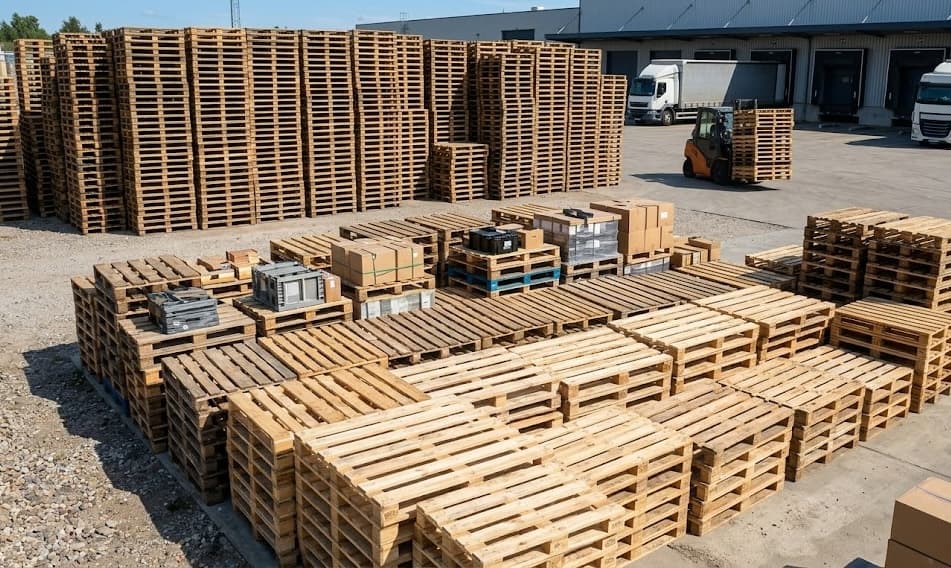
Many pallets are discarded after a single trip even though they still have useful life left. AtSD Re Pallet, we help San Diego County businesses source recycled pallets from partner suppliers as an alternative to buying new.
For many applications, a good recycled pallet does the same job as a new one and typically costs less. Recycled pallets are usually sorted, and damaged ones repaired by replacing deck boards, reinforcing stringers, and re-nailing loose connections. Partner suppliers in our network can supply recycled pallets in the grade your loads call for, and pricing varies by supplier, grade, and volume.
Reusing a pallet also avoids building a new one. A standard 48x40 wood pallet weighs roughly 40 to 60 pounds, so across an order of hundreds of pallets, reuse keeps a meaningful amount of wood in service instead of sending it to a landfill.
Product Categories
From standard GMA pallets to fully custom builds, partner suppliers in our network can supply the pallets San Diego County businesses use every day.
Wood Pallets
Grade A, B, and C recycled wood pallets in standard and non-standard sizes, with hardwood and softwood options for most applications.
- GMA 48x40 & custom sizes
- Hardwood & softwood
- Grades A through C
Plastic Pallets
HDPE and polypropylene pallets built for hygiene-sensitive industries. Common in food processing, pharmaceuticals, and closed-loop systems.
- HDPE & PP materials
- Washable surfaces
- Long service life
Custom Pallets
Pallets built to your specifications. Partner suppliers in our network can build custom sizes, strengths, and configurations for oversized equipment, specialty products, and unique racking systems.
- Any size or dimension
- Built for your load
- Small and large runs
Pallet Accessories
Collars, covers, corner protectors, anti-slip pads, dunnage, and everything else you need to secure and protect your palletized loads.
- Pallet collars & lids
- Corner protectors
- Anti-slip solutions
Reclaimed Wood Products
Rustic, character-rich reclaimed pallet wood for DIY projects, wall paneling, furniture making, planters, and commercial interior design.
- Furniture-grade boards
- Wall paneling
- Planters & shelving
Used vs. New Pallets: What You Need to Know
New Pallets
New pallets are manufactured from freshly milled lumber. They offer uniform appearance, consistent dimensions, and predictable strength. New pallets are the right choice when you need heat-treated (ISPM-15 compliant) pallets for international export, or when your customer or industry requires brand-new materials for hygiene or branding reasons.
New pallets are available through partner suppliers in standard GMA 48x40 dimensions as well as custom sizes. They can be built from Southern Yellow Pine, Oak, or other hardwood and softwood species depending on your load requirements.
Recycled Pallets
Recycled pallets are previously used pallets that have been sorted and, where needed, repaired and reconditioned. They are typically sorted into Grade A, B, and C categories based on their condition, and priced accordingly. Grade A recycled pallets are in good condition and perform close to new pallets in most applications.
For domestic shipping, warehouse storage, and most supply chain applications, recycled pallets are often the most cost-effective option. They can handle typical loads while keeping costs down and reusing material that has already been made.
Product Comparison: All Pallet Types Side by Side
Choosing the right pallet starts with understanding the strengths and trade-offs of each type. This comparison covers durability, load capacity, and best-fit applications. Figures are general industry ranges; actual specs vary by supplier. Pricing is by quote from partner suppliers and depends on grade, size, quantity and timing.
| Feature | Wood (Recycled) | Wood (New) | Plastic (HDPE/PP) | Custom Built |
|---|---|---|---|---|
| Static Load Capacity | 2,500 - 4,000 lbs | 2,500 - 5,000 lbs | 5,000 - 30,000 lbs | Up to 10,000+ lbs |
| Dynamic Load Capacity | 1,800 - 2,800 lbs | 2,000 - 3,200 lbs | 2,500 - 5,000 lbs | Engineered to spec |
| Weight (48x40) | 40 - 60 lbs | 40 - 70 lbs | 35 - 50 lbs | 25 - 150+ lbs |
| ISPM-15 Export Ready | Requires heat treatment | Available with HT stamp | Exempt (no treatment) | Available with HT |
| Moisture Resistance | Low | Low-Medium | Waterproof | Material dependent |
| Repairability | Easily repaired | Easily repaired | Not field-repairable | Repairable (wood) |
| Best For | Domestic shipping, cost savings | Export, retail display | Food, pharma, closed-loop | Oversized, specialty loads |
Pricing and Lead Times
Pricing is by quote from partner suppliers and depends on grade, size, quantity and timing. Lead times depend on the supplier, the product, and current stock; the partner supplier that quotes your order will confirm timing. Request a quote with your expected volume and schedule and we will pass it to a partner supplier in our network.
What to Look For in Pallet Quality
Pallet quality matters because your products and operations depend on the pallets performing as expected. When you request a quote, tell us the grade, dimensions, and load requirements you need so the partner supplier we match you with can quote accordingly.
Replacement and return terms are set by the supplier that fulfils your order, so confirm them with the supplier before you buy, especially on large orders.
For recycled wood pallets, common quality checks include looking at stringers for cracks, splits, and notch damage; making sure deck boards are securely fastened; confirming dimensions match the stated size; and sorting by grade. Learn more about how the process works.
Structural Condition
Check stringers and deck boards for cracks, loose boards, or protruding nails. Pallets with these issues are normally repaired or set aside before grading.
Grade Consistency
Grades are not formally standardized across the industry, so agree on what Grade A, B, or C means with your supplier and spot-check deliveries against it.
Supplier Terms
Ask the supplier how they handle pallets that do not match the ordered grade, and how quickly issues should be reported after delivery.
How to Choose the Right Pallet: A Decision Guide
Not sure which pallet type is best for your application? Walk through these five key questions to narrow your choice quickly.
1. What is your load weight?
For loads under 2,000 pounds, a standard recycled Grade B wood pallet handles the job at the lowest cost. Loads between 2,000 and 5,000 pounds benefit from Grade A hardwood or plastic pallets. Loads over 5,000 pounds typically require custom-engineered pallets with reinforced stringers or block construction.
2. Is this for domestic or international shipping?
Domestic shipping allows maximum flexibility. Recycled wood pallets are the most cost-effective choice for moves within the United States. International exports require ISPM-15 compliance, which means either heat-treated wood pallets with proper IPPC stamps, or plastic pallets that are exempt from phytosanitary regulations entirely.
3. Is hygiene a regulatory requirement?
Food processing and pharmaceutical operations often specify plastic pallets because their non-porous surfaces can be washed and sanitized between uses. Requirements differ by product and customer, so check current regulations and your customers' specifications before choosing between plastic and clean Grade A wood.
4. One-way shipping or closed-loop system?
If your pallets leave your facility and do not come back (one-way shipping), recycled wood pallets deliver the lowest per-shipment cost. If your pallets circulate within a closed-loop system between your facilities or between you and known partners, plastic pallets can offer a lower cost per trip over their long service life, despite the higher upfront investment.
5. Do standard dimensions work, or do you need a custom size?
The standard GMA 48x40 pallet is the most common size in U.S. supply chains and fits many applications. If your product dimensions, racking configuration, or trailer layout requires a non-standard footprint, custom pallets can be built in a wide range of sizes, from small 24-inch footprints to 120 inches or larger. Check our Pallet Size Guide to see if a standard size fits before investing in custom.
Still not sure? Request a quote with your requirements and we will pass them to a partner supplier in our network who can recommend a suitable product. Ask the supplier about sample pallets for testing before you commit to a large order.
Need More Than Just Pallets?
Partner suppliers in our network also offer pallet services including recycling, removal, repair, and heat treatment.
Explore Services