Pallet Recycling
Giving every pallet a second, third, and fourth life. Our recycling program keeps wood out of landfills and quality pallets in your supply chain.
Start Recycling Your Pallets
Tell us about your pallet volume and we will set up a recycling program tailored to your operation.
Our Recycling Process, Step by Step
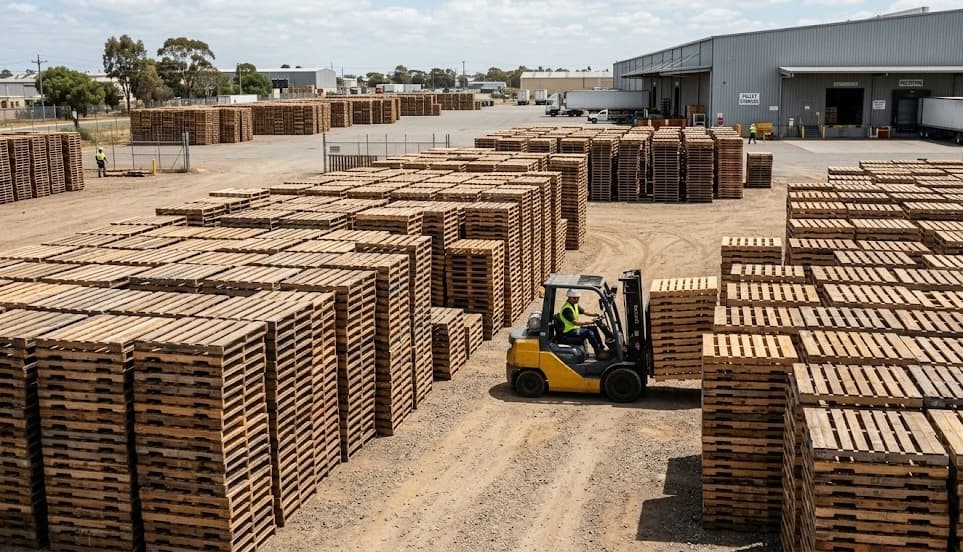
Pallet recycling is the core of our business at SD Re Pallet. Every week, we process thousands of used pallets from San Diego businesses, transforming what would otherwise become landfill waste into high-quality, ready-to-ship pallets. Our recycling process is systematic, quality-controlled, and designed to extract maximum value from every piece of wood.
Collection
We collect used pallets from businesses throughout San Diego County. Our free removal service picks up pallets from your dock, yard, or warehouse on a schedule that works for you. For businesses generating consistent pallet volumes, we set up recurring weekly or bi-weekly pickups. You can also deliver pallets to our facility yourself.
Sorting and Inspection
Every pallet that enters our facility is individually inspected by trained workers. We evaluate the structural integrity of each stringer, check every deck board for cracks and rot, and assess overall dimensional accuracy. Pallets are sorted into three categories: pallets that can go directly back into service (Grade A), pallets that need repair, and pallets that have reached end of life and must be dismantled for parts or ground into mulch.
Repair and Reconditioning
Pallets that need repair go to our repair line where skilled technicians replace broken deck boards, reinforce damaged stringers, re-nail loose connections, and restore the pallet to a condition that meets our quality standards. We use quality lumber for all replacement boards to ensure repaired pallets perform as well as unrepaired ones.
Grading and Stacking
After repair, every pallet undergoes a final quality check and is graded as Grade A, B, or C based on its condition. Graded pallets are stacked by size and grade in our yard, ready for immediate sale and delivery to our customers.
Redistribution
Recycled pallets re-enter the supply chain through our sales program. Businesses across San Diego buy our recycled pallets for domestic shipping, warehouse storage, and distribution. This closed loop means the pallets you send us for recycling become the pallets another business uses to ship their products.
What Happens to Damaged Pallets
Not every pallet can be repaired and put back into shipping service. Pallets with extensive rot, multiple broken stringers, or significant structural compromise have reached the end of their life as shipping platforms. But even these pallets do not go to waste in our system.
Pallets that cannot be repaired are carefully dismantled. Boards that are still structurally sound become replacement parts for repairing other pallets. Shorter or narrower usable pieces become blocking, dunnage, or raw material for custom pallet manufacturing.
Wood that is too damaged for any reuse is ground into mulch and wood chips. This biomass is used for landscaping mulch, animal bedding, and playground surfacing. In some cases, ground wood is used as fuel for biomass energy generation. The bottom line is that virtually zero wood enters our facility and leaves as landfill waste.
Boards with special character from aging and wear are set aside for our reclaimed wood products program, where they find new life as furniture, wall paneling, and decorative items.
Environmental Benefits
Landfill Diversion
Pallets make up a significant percentage of municipal solid waste. Our recycling program diverts thousands of tons of wood from San Diego landfills annually, extending landfill capacity and reducing waste management costs for the region.
Carbon Sequestration
Wood stores carbon. When pallets are recycled and kept in use, the carbon remains locked in the wood rather than being released through decomposition or incineration. Each pallet we recycle keeps approximately 20 kg of CO2 equivalent out of the atmosphere.
Reduced Logging
Every recycled pallet that re-enters the supply chain is one fewer new pallet that needs to be manufactured from virgin lumber. This reduces demand for logging, preserves forests, and protects the biodiversity that depends on healthy forest ecosystems.
Energy Savings
Manufacturing a new pallet from raw lumber requires harvesting, transporting, milling, drying, and assembling wood. Recycling an existing pallet uses a fraction of that energy. The total energy savings across our recycling program amount to significant reductions in fossil fuel consumption.
Read our full Sustainability Report for detailed environmental metrics and our Sustainability Mission for our long-term commitments.
Material Recovery Rates
Our recycling process is designed to extract maximum value from every pallet. Here is a breakdown of where the material goes and the recovery rate for each stream.
| Material Stream | Recovery Rate | End Use | Annual Volume (est.) |
|---|---|---|---|
| Whole pallets (reuse as-is) | 35-40% | Direct resale as Grade A/B | ~85,000 pallets |
| Repaired pallets | 30-35% | Resale after board/stringer repair | ~70,000 pallets |
| Salvaged lumber | 15-20% | Repair parts, custom builds, dunnage | ~180 tons |
| Wood mulch / biomass | 8-12% | Landscaping, animal bedding, fuel | ~120 tons |
| Reclaimed character wood | 1-2% | Furniture, wall paneling, art | ~15 tons |
| Metal (nails, brackets) | 100% | Scrap metal recycling | ~8 tons |
Combined, these streams yield a total material recovery rate above 95%, meaning less than 5% of material entering our facility ends up in a landfill.
Environmental Certifications and Compliance
SD Re Pallet operates in full compliance with local, state, and federal environmental regulations governing wood waste processing and recycling operations. Our facility holds the following certifications and memberships:
National Wooden Pallet & Container Association (NWPCA)
Industry association membership ensuring adherence to best practices in pallet manufacturing, repair, and recycling.
ISPM-15 Certified Treatment Facility
USDA APHIS approved for heat treatment of wood packaging material for international export compliance.
San Diego County Environmental Compliance
Fully permitted for wood waste processing, stormwater management, and dust control at our recycling facility.
CalRecycle Compliance
Registered with California's Department of Resources Recycling and Recovery for wood waste diversion reporting.
Detailed certification documents are available on our certifications page. We provide copies to customers upon request for their sustainability audits and vendor qualification processes.
Materials We Accept and Reject
We Accept
- ✓Standard GMA 48x40 wood pallets (all conditions)
- ✓Non-standard and custom-size wood pallets
- ✓Stringer pallets and block pallets
- ✓Hardwood and softwood construction
- ✓Pallets with normal wear, dirt, staining, and weathering
- ✓Broken pallets with salvageable lumber
- ✓Heat-treated and stamped pallets
- ✓Pallet collars and wood packaging frames
- ✓Loose lumber, dunnage, and blocking material
- ✓Plastic pallets in repairable condition
We Cannot Accept
- ✕Pallets contaminated with hazardous chemicals
- ✕Pallets soaked with oil, solvents, or petroleum products
- ✕Wood exposed to biohazards or medical waste
- ✕Pallets treated with methyl bromide (MB stamp)
- ✕Pallets with heavy mold infestation throughout
- ✕Painted pallets with lead-based coatings
- ✕Metal or composite pallets (we recycle wood only)
- ✕Pallets containing asbestos or regulated materials
Not sure if your pallets qualify? Send us photos or call us. We are happy to advise on what can be recycled. In borderline cases, we can arrange a site visit to inspect the material before committing to pickup.
Recycling vs. Disposal: The Cost Comparison
Many businesses default to paying a waste hauler to remove pallets. Here is what that actually costs compared to recycling with SD Re Pallet.
| Cost Factor | Waste Hauler Disposal | SD Re Pallet Recycling |
|---|---|---|
| Pickup / hauling fee | $150-$400 per load | Free (50+ pallets) |
| Landfill tipping fee | $45-$75 per ton | $0 (no landfill) |
| Value recovery | $0 (pallets are destroyed) | Paid for sellable pallets |
| Sustainability reporting | None provided | Diversion certificates available |
| Net annual cost (500 pallets/mo.) | $3,600 - $8,400 | $0 or net positive |
The math is straightforward. Recycling eliminates disposal costs, often generates revenue from sellable pallets, and provides documentation for your sustainability initiatives. There is no scenario where paying a waste hauler to landfill pallets makes financial sense when recycling is available.
Processing Capacity and Volume Capabilities
5,000+
Pallets processed weekly
95%+
Landfill diversion rate
250K+
Pallets recycled annually
1,200+
Tons of wood diverted yearly
Our facility is equipped to handle recycling volumes from a few dozen pallets per month to thousands per week. We serve businesses of every size, from local retailers and small manufacturers to regional distribution centers and national logistics providers with San Diego operations.
For small volumes of fewer than 50 pallets, we can arrange on-call pickups or you can deliver to our yard during business hours. For medium volumes of 50 to 500 pallets per month, we set up weekly scheduled pickups. For high-volume operations generating 500 or more pallets per month, our pallet management program provides dedicated service with on-site sorting, real-time inventory tracking, and priority scheduling.
No matter your volume, we make recycling easy. We handle the heavy lifting, the transportation, and the sorting. You just tell us when the pallets are ready, and we take it from there.
Frequently Asked Questions
Which pallets and wood products can you recycle?
We accept wood pallets, crates, and skids in most sizes. Usable pallets are repaired; scrap is ground for mulch or fuel.
How do I schedule a recycling pickup?
Submit the form with quantity and address. For urgent pickups call us—same-day runs are often available in San Diego.
Do you charge for recycling pickups?
Reusable pallets may generate a rebate. Mixed or heavily broken loads can include a modest haul-away or processing fee.
Can you drop a trailer for ongoing recycling?
Yes. We can stage a live- or drop-trailer so your team loads scrap steadily; we swap on a set schedule.
How are recycled pallets processed?
We sort by condition, repair what can be reused, harvest parts, and grind remaining wood into mulch or biomass.
Do you provide diversion reporting?
Yes. We can supply monthly or quarterly reports showing pallet counts, weights, and landfill diversion totals.
Can you handle contaminated or wet pallets?
Light dirt is fine; pallets with chemicals, food waste, or mold are assessed case by case and may require special handling fees.
Do you accept plastic pallets for recycling?
We evaluate plastic pallets separately and can reclaim or resell certain types; share photos for confirmation.
What is the turnaround for trailer swaps?
Standard swaps are 24–48 hours; rush swaps can often be done same day depending on route availability.
Can you integrate recycling with buy/sell programs?
Yes. We bundle recycling with pallet purchasing and delivery so you get one vendor for all pallet flows.